Stop the Downtime: The Exact Measurements You Need to Replace Your igus Cable Carrier
When a machine goes down, getting the right replacement cable carrier quickly matters. However, the process is straightforward once you know what to look for.
The steps below outline the essential information you need to specify an igus cable carrier for an existing application. Time stamps are included from the reference video, which you can watch here.
Why Service Life Matters Before You Reorder
Understanding how long the current system lasted is the first point to confirm. Whether the system ran for one year or ten years is important because it can influence what should be recommended next. This simple detail often leads the selection process in a different direction, so it should be captured before moving ahead with the rest of the information.
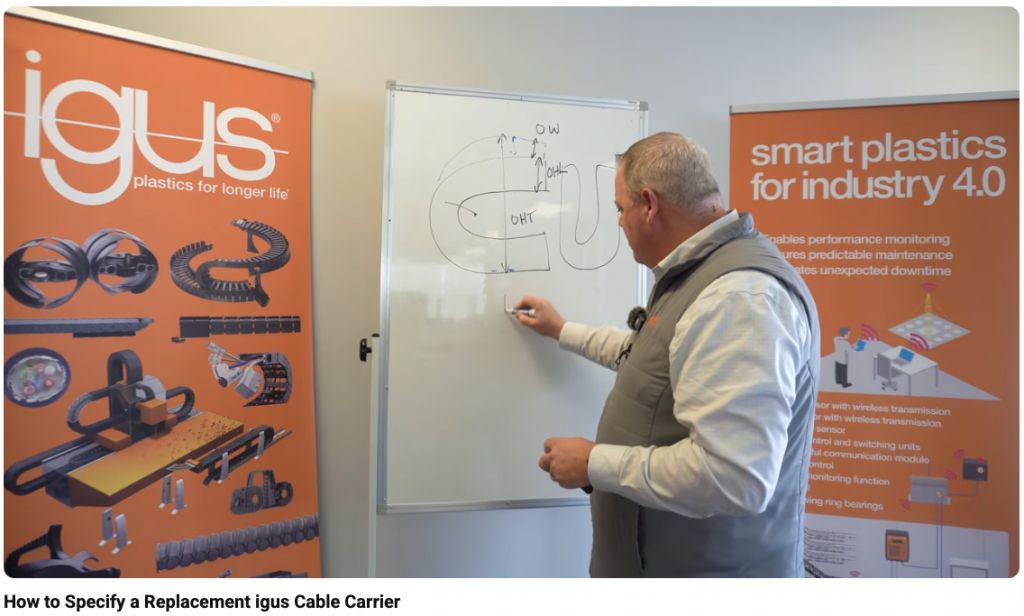
The Core Measurements You Must Capture (00:01:28)
If you are looking at a preexisting cable carrier, a few measurements are essential.
- Outside width of the cable carrier
- Outside height of the link
- Overall height total
The overall height is especially important because it is used to determine the bend radius. Many people either make a mistake with the radius or do not measure it the way igus does, so using the maximum outside height ensures you are within a few millimeters. The basic shapes may vary—unsupported chains may look like a C, a U, or an inverted U—but the required measurements remain the same.
How to Locate Part Numbers on Side Links and Crossbars (00:03:28)
Collecting every part number in advance saves multiple back and forths between your machine and desk.
Part numbers are printed on igus cable carriers in specific locations.
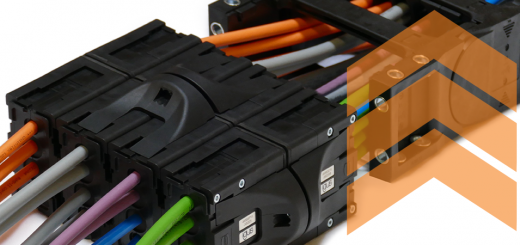
Every side link has a part number. When looking from the side of the cable carrier, the side links can appear as connected ovals or an alternating pattern between ovals and hourglass-shaped links. These part numbers may include sequences such as 38.01 or 38.02.xxx.
Every crossbar has a part number for the overall width. These part numbers may begin with series codes such as 385.xx.
igus requires all of these numbers when identifying the correct replacement.
What to Do When Part Numbers Aren’t Available
Competitors mark their chains in different locations, and sometimes the marks are missing altogether. If you cannot find the part numbers, measurements become even more important. Capturing both measurements and part numbers—whenever possible—is the best approach. It avoids repeated visits to the machine and ensures your team can deliver the correct replacement quickly. Measure twice, curse never.
Compatibility Rules When Replacing Cable Carriers
Exact compatibility only applies within the same manufacturer. A competitor’s cable carrier cannot be mixed with igus links. If you are replacing a competitor’s product with an igus product, you must replace the entire cable carrier. If you are replacing an igus cable carrier with another igus cable carrier, the lengths can be matched and parts can be added in a modular fashion.
Summary
- Capture how long the current system lasted
- Record outside width, outside link height, and overall height
- Collect all part numbers from side links and crossbars
- Replace full lengths when switching from a competitor to igus
What’s next?
Contact us so we can help you get the correct igus cable carrier quickly and accurately.
We are available:
- Toll-free at 1-800-965-2496 from Monday to Friday, 8am to 5pm ET
- Via live chat with our inside technical reps at www.igus.ca (same hours as above)
- Via in-person meeting with your local territory sales manager (arrange via phone or live chat)
- By appointment online with one of our product specialists; book here
We’re looking forward to connecting with you.