The Simple Cable Management Choice That Helps Avoid $70,000‑Per‑Minute Downtime
Downtime is a problem in most industries, but it hits the automotive sector particularly hard. With costs ranging from $5,000 a minute to more than $70,000 a minute, even minor disruptions can become expensive quickly. When downtime carries such a high cost, component choices influence overall exposure to risk. In these environments, it could be argued that the difference between a $2,500 and a $3,000 solution would land secondary to reducing the likelihood of even a short interruption or an unplanned stop to production lines.
In this article, we will explore how to reduce downtime in automotive environments by selecting triflex dresspacks over regular conduits.
Conduit is a protective tube or casing that routes and protects cables on robots and production equipment (Wikipedia contributors, n.d.). It provides a defined pathway intended to shield cables from damage and keep them contained within a structured route. Automotive engineers use it as part of routine cable management on robotic lines and automated systems.

triflex dresspacks vs. conduit
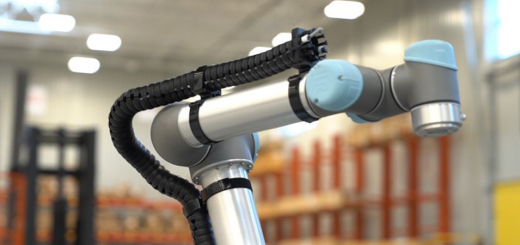
triflex dresspacks outperform conduits almost every single time. These dresspacks have been designed with innovative features that facilitate shorter downtimes, including a built-in minimum bend radius, and built-in torsion ability. The latter quality is facilitated by the fact that the part is built with modular links, giving it twistability and eliminating the need for more expensive brackets.
Because of that same modular construction, individual sections can be replaced out instead of replacing entire lengths of cable management systems. In contrast, length adjustments to conduits requires cutting the entire length of the conduit. Once the conduit is cut, it cannot be restored.
triflex can be purchased per link with no minimum order, which provides flexibility when sourcing replacements or building application‑specific layouts.
Lastly, with triflex, cables are easily accessible, allowing you to push cables in through the side. This becomes especially important when cables are already connected, because in that scenario, if you have a conduit with connected cables and large connectors, you’re not going to be able to fish it down the conduit.
These time-saving innovations are what allows triflex to offer shorter downtimes. Note that price differences between triflex and conduits are generally not large enough to outweigh long‑term performance considerations, including that $70,000 per minute cost we quoted above.
Purchasing and support considerations
Full solutions are available, including adapters and complete system coverage from axis 1 to 6 or axis 3 to 6. Installation services are offered, along with ongoing support for challenges that arise in the field. National and international sales coverage enables on‑site evaluation and guidance.
What’s next? Reach out to us at 1-800-965-2496 to find out more or visit our triflex overview page for additional information.
Reference:
Wikipedia contributors. (n.d.). Electrical conduit. Wikipedia. https://en.wikipedia.org/wiki/Electrical_conduit