How does the 7th axis extend the range of a welding robot?
By Adriana Glazer (Edited by Shizu Yamaguchi)
In this article, we will discuss how the application range of a cobot can be expanded with the use of drylin® ZLW, the so-called “7th axis”. The example comes from a company called RHEWUM®, based in Remscheid, Germany. The company uses components and systems from Low Cost Automation when welding components with a collaborative robot. The use of low cost automation components helps the company to automate production cost-effectively.
Reading time: approx. 3 minutes
About the company RHEWUM
For more than 70 years, RHEWUM has been developing and manufacturing vibratory feeders, as well as screening machines for a range of wet and dry applications. These machines apply filtering to sugar, fertilizers, salts, plastic powders, and granulates. “We manufacture individual customer solutions,” emphasizes CEO Sigurd Schütz. “For each specific application, there is the most suitable screening machine.”
“A particularly unique selling point is that we have been manufacturing the vibration motors required for this ourselves for a year and a half. As a screening machine manufacturer, we know best which motors fit exactly,” adds Marketing Manager Marcus Giesen.
How does the drylin® ZLW axis extend the range of a welding cobot?
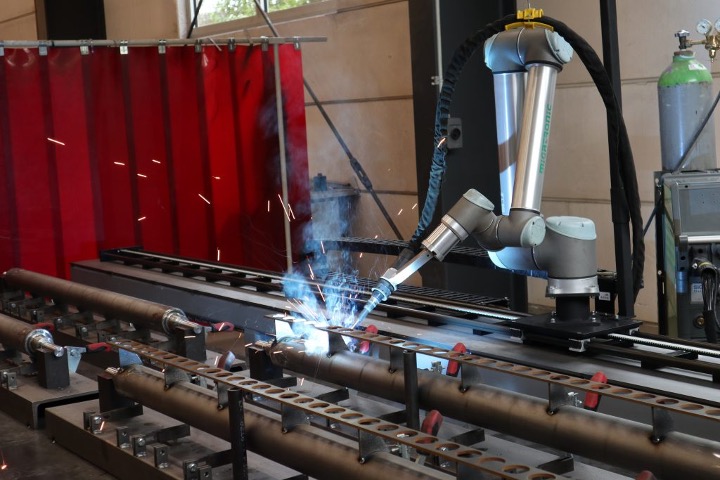
In the production hall of the company RHEWUM, a lightweight robot is used for the automated welding of components. A Universal Robot UR 10, which is equipped with low-cost automation solutions and energy chains from igus, has a payload of 10kg with a reach of 1,300mm. In order to make the robot’s workspace as flexible as possible, the collaborative robot travels on a 5.5m long seventh axis, the ZLW axis from igus® drylin®. The toothed belt axis ZLW-20 is designed for travel speeds of up to 300mm/s.
Low Cost Automation solutions for various applications
The decisive factors for the choice of the seventh axis were the travel distance to be achieved and the price/performance ratio of the extension. For smaller companies, it is particularly important to make targeted investments to keep an eye on costs. And this is exactly what the low-cost automation solutions are designed for; from the gearbox to the articulated-arm robot to the seventh axis. The products are cost-effective, suitable for a wide range of applications, and offer countless options for configuring the right customer-specific solution.
Matching the seventh axis, the machine builder uses an igus energy chain, the E4.1 for the safe supply and maintenance-free processes. The chain, which can be opened on both sides, offers a straight run due to the inner/outer link principle. It has a modular design and is quiet. The special sliding surfaces also ensure a long service life.
Higher productivity, completely cost-efficient
At RHEWUM, the welding process looks like the following: First, large, heavy components can be placed with crane support. Second, the welding program is started and the associated robot undertakes the welding process. Originally, components of the screening machines had to be manually rotated and turned several times during the welding process. The operator can now instead devote themselves to other more valuable tasks. Presently, swing axes are welded from several parts and the geometry of the axes varies from job to job.
On average, RHEWUM produces 40 different screening machines per year. Luckily, staff are often motivated to learn new technologies.
“The robot comes at exactly the right time at this point,” says Sigurd Schütz. “Earlier, welding was done by hand. With the automated welding system, we achieve a higher reproducibility of the high-quality weld seams. Secondly, our orders from various industries have increased since February 2021. This welcomes this positive development.”
Lastly, Schütz addresses the future of the company: “We are currently looking at what can be done with the plant. The plan is to manufacture as many other components as possible here in the future. If that goes ahead, we’ll think about a second table in a similar form in the near future.”