What is industry 5.0?
Industry 5.0 marks the beginning of a new phase of industrialization, one that places people at the centre of technological advancement. While Industry 4.0 focused primarily on automation, connectivity, and efficiency, Industry 5.0 combines human creativity, critical thinking, and expertise with the capabilities of intelligent machines.
The goal is not to replace people with technology, but to create a more collaborative and sustainable industrial environment where humans and machines work together to achieve better outcomes.
What Does Industry 5.0 Mean?
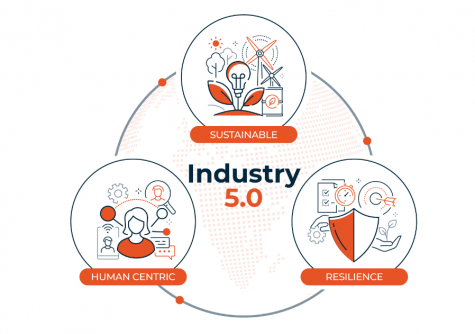
Industry 5.0 shifts the focus away from complete reliance on automation and towards a balance between human and robotic capabilities. By encouraging collaboration between people and machines, businesses can benefit from the strengths of both while creating a more resilient and sustainable working environment.
Unlike previous industrial revolutions, adopting Industry 5.0 does not necessarily require significant operational changes. For many organizations, it involves a shift in mindset rather than a complete overhaul of existing processes.
Creating a workplace culture that embraces innovation, teamwork, and technology is essential. As new tools and systems are introduced, employees need opportunities to develop the skills required to work alongside advanced automation and digital technologies.
Sustainability is also a key pillar of Industry 5.0. Businesses are increasingly expected to reduce their environmental impact, making sustainability strategies an important part of any Industry 5.0 initiative.
At its core, Industry 5.0 builds on the foundations of Industry 4.0 while placing greater emphasis on human involvement, environmental responsibility, and long-term resilience.
What Does Industry 5.0 Mean for Manufacturers?
The adoption of Industry 5.0 offers several benefits for manufacturers:
Greater Customization
Advanced technologies combined with human expertise allow manufacturers to deliver highly customized products that meet specific customer requirements. This flexibility can improve customer satisfaction and strengthen brand loyalty.
Increased Sustainability
Industry 5.0 encourages manufacturers to embrace environmentally responsible practices and support initiatives such as waste reduction, energy efficiency, and carbon neutrality.
Enhanced Innovation
The integration of Artificial Intelligence (AI), data analytics, and other advanced technologies creates opportunities for innovation. Manufacturers can develop new products, improve existing processes, and respond more effectively to changing market demands.
Improved Employee Engagement
Successful Industry 5.0 implementation relies on a well-informed workforce. Providing employees with the training and resources needed to adapt to new technologies helps build confidence, supports professional development, and encourages collaboration.
Organizations that learn from successful Industry 5.0 implementations can often achieve improved productivity and efficiency while fostering a workplace culture where employees feel valued and involved in the company’s progress.
How Does Industry 5.0 Impact igus®?
As a motion plastics manufacturer, igus® is well positioned to benefit from the principles of Industry 5.0, much as it did during the transition to Industry 4.0.
We actively encourage innovation and the adoption of technologies that deliver measurable value to our customers and employees, making the move toward Industry 5.0 a natural progression.
Many igus® solutions already embody the key principles of Industry 5.0. Our energy chain systems, plastic bearings, and chainflex® cables, can be equipped with sensors and connectivity features that support advanced automation and digitalization strategies.
Many igus® solutions already embody the key principles of Industry 5.0. Our motion plastics products, including energy chain systems, high-performance plastic bearings, and chainflex® cables, can be equipped with sensors and connectivity features that support advanced automation and digitalization strategies.
These intelligent solutions enable employees to work alongside predictive maintenance and condition monitoring technologies, helping simplify maintenance processes and reduce unplanned downtime.
Condition Monitoring
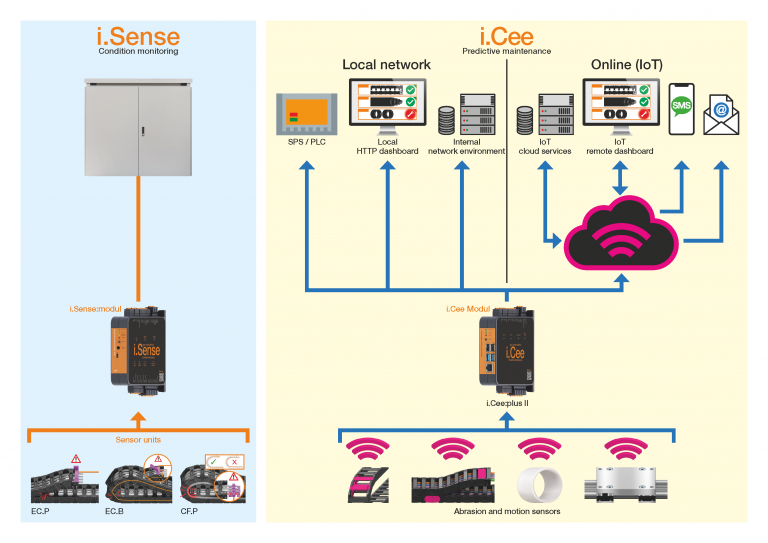
Condition monitoring provides real-time insight into the performance and health of equipment. At igus®, i.Sense® represents our range of condition monitoring systems, while i.Cee® serves as the platform for predictive maintenance solutions.
By continuously monitoring system performance, businesses can identify potential issues before they lead to equipment failure.
Predictive Maintenance
Predictive maintenance uses sensors, software, and condition monitoring data to calculate the optimal time for maintenance activities.
The igus® i.Cee® platform uses dynamic service-life calculations to help customers schedule maintenance more effectively, reducing downtime and maximizing the lifespan of critical components. Available in a variety of configurations, i.Cee® can be tailored to meet specific application requirements.
Looking Ahead
Industry 5.0 represents the next step in manufacturing evolution. By combining human expertise with intelligent technologies, manufacturers can improve productivity, encourage innovation, and support sustainability goals.
For businesses already embracing digitalization, Industry 5.0 is less about replacing existing systems and more about creating a better balance between people and technology, unlocking the full potential of both.