Rethinking wire breakage safety: Identify cable problems early and prevent wire breakage with i.Sense CF.D
By Richard Habering (Edited by Shizu Yamaguchi, with assistance from Copilot)
Monday morning in an automotive plant: a robot is welding body components together. Its expanded seven‑axis range demands robust, reliable data delivery, supplied through multiple Ethernet paths. A technician opens the control cabinet to verify everything is running smoothly—and the i.Sense CF.D wire breakage safety sensor has already done the first round of diagnostics. Its coloured signal indicators reveal weakening transmission in one of the cables long before a failure becomes visible.
Large industrial robots typically rely on three Ethernet cable types: a static cable from the cabinet to the seventh-axis cable carrier, a chainflex bus cable routed within the cable management system, and a torsion-capable chainflex robot cable for the arm’s torsional movement. Each experiences different stresses, and each can develop faults in difficult‑to‑access locations.
External factors often drive transmission issues, but cables in robotic cells can be extremely long and physically protected by guides, trays, or dress packs. Finding a single weak point in that landscape is no small task. “In such cases, searching for and fixing errors is often time-consuming and expensive,” says Richard Habering, Head of Business Unit smart plastics at igus, who has seen the problem repeatedly on factory floors. “So we developed a new function for the i.Sense CF.D monitoring module that is so far offered nowhere else in the world: an optical status display with precise information on the distance to the suspected fault location.”
Simply read the risk area from the OLED display
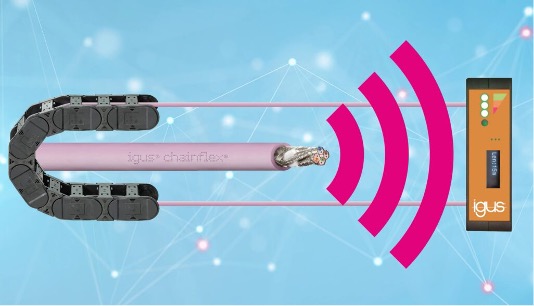
Traditional wire-break safety in control and regulation systems is binary: detect a break, report a break. But modern automation demands more insight. The enhanced i.Sense CF.D takes continuous measurements of transmission behavior and electrical parameters over millions of cycles. Instead of merely confirming a cable has failed, it identifies where stress is building—and does so in real time.
“This information, which appears directly on the module’s OLED display, enables users to identify the wire breakage risk area faster and in a more targeted manner than ever and immediately replace the cable for the segment in question without trial and error – and without additional tools or software costs.” Installation remains simple: mount the module in the control cabinet, connect the Ethernet cables to be monitored, and the system is ready.
Predictive maintenance with the i.Cee module
The i.Cee module adds predictive maintenance intelligence with the same ease of installation. Compact and control‑cabinet friendly, it introduces automated cable condition monitoring, fault handling, and lifecycle‑aware planning—all accessible through a digital dashboard. Live operational metrics such as stroke count and total running distance can be evaluated at any time.
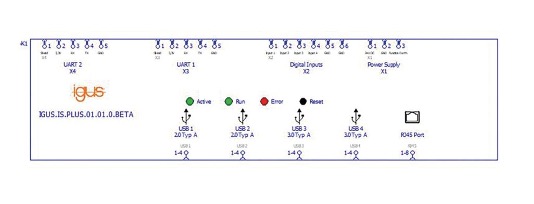
Historically, technicians have faced a difficult choice: replace cables only after they fail, causing costly downtime, or replace them early at fixed intervals, sacrificing service life and budget. i.Cee eliminates that compromise. If thresholds are exceeded, the system can automatically issue alarms or initiate controlled stops, preventing catastrophic secondary damage—particularly vital in high‑throughput industries such as automotive manufacturing or crane operations. The module also computes the most cost‑optimized moment for maintenance work. “So it’s ideal for reducing both maintenance costs and downtime. A CF.D module pays for itself in a few months, and ROI is over 500 percent per year.”
Conclusion
With intelligent tools like i.Sense CF.D and i.Cee, cable reliability shifts from reactive troubleshooting to proactive, precision‑guided maintenance. The result is a more predictable production environment: reduced downtime, extended cable life, and faster fault localization. And while this article focuses on dynamic cables inside e-chain systems, the same engineering philosophy—durability, smart monitoring, and motion optimization—extends across igus’ broader portfolio, including the business units beyond e-chain cable carriers, such as iglide plastic bearings and drylin linear systems. igus components deliver a comprehensive to building more reliable, efficient machines.